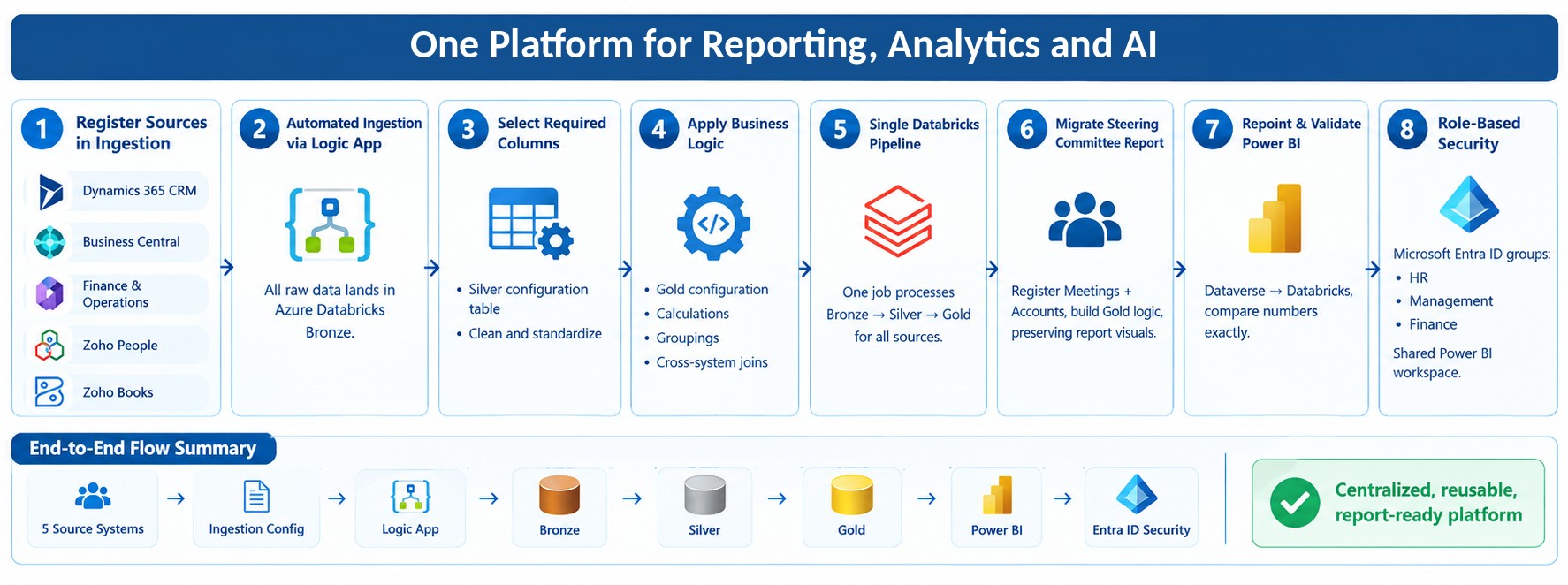

Building a Reliable Bronze Silver Gold Data Pipeline in Databricks for Enterprise Reporting
Summary
Modern analytics platforms require structured data pipelines that ensure reliability, consistency, and governance across reporting systems. Traditional ETL approaches often struggle to scale as data volume and complexity increase.
This blog explains how the Bronze–Silver–Gold (Medallion) architecture in Databricks provides a scalable and reliable framework for organizing data pipelines. It highlights how each layer serves a specific purpose, enabling better data quality, governance, and seamless integration with reporting tools such as Power BI.
The Real Problem: Reporting Pipelines Become Fragile Over Time
In many organizations:
- a. Reports directly query raw data
- b. Transformation logic is embedded in BI tools
- c. Data inconsistencies appear across reports
- d. Performance degrades as data grows
This leads to unreliable reporting and increased maintenance effort.
What Is the Bronze–Silver–Gold Architecture?
The Medallion architecture organizes data into three layers:
Bronze Layer
Raw data ingestion layer.
Silver Layer
Cleaned and standardized data.
Gold Layer
Business-ready, reporting-optimized data. Each layer has a clear responsibility.
Bronze Layer: Raw Data Ingestion
Purpose
- a. Capture data exactly as received
- b. Preserve original structure
- c. Maintain full history
Key Characteristics
- a. Append-only storage
- b. Minimal transformation
- c. Includes ingestion metadata
Bronze acts as the system of record.
Silver Layer: Data Standardization
Purpose
- a. Clean and validate data
- b. Select required fields
- c. Apply consistent naming
Key Activities
- a. Data type normalization
- b. Filtering invalid records
- c. Removing duplicates
- d. Basic business logic
Silver creates reusable datasets across reporting use cases.
Gold Layer: Reporting-Ready Data
Purpose
- 1. Provide optimized datasets for analytics
- 2. Simplify reporting queries
Key Characteristics
- 1. Denormalized tables
- 2. Aggregations applied
- 3. Stable schema
Gold tables are consumed directly by reporting tools.
Why This Architecture Works
1. Separation of Concerns
Each layer has a defined role, reducing complexity.
2. Improved Data Quality
Data is progressively refined from raw to curated.
3. Better Performance
Reporting queries run on optimized Gold tables.
4. Governance with Unity Catalog
Access can be controlled at each layer:
- a. Engineers access Bronze/Silver
- b. Business users access Gold
Common Implementation Mistakes
- a. Allowing reporting tools to access Bronze
- b. Performing heavy transformations in Gold
- c. Skipping Silver layer
- d. Mixing business logic across layers
These mistakes lead to long-term instability.
Business Impact
- a. Reliable and consistent reporting
- b. Reduced dependency on BI tool transformations
- c. Faster report refresh times
- d. Clear data ownership
- e. Scalable architecture for future growth
To conclude, the Bronze–Silver–Gold architecture provides a strong foundation for building scalable and reliable data pipelines in Databricks.
When combined with proper governance and disciplined design, it enables organizations to deliver consistent, high-quality data for analytics and decision-making.
We hope you found this article useful. If you would like to explore how AI-powered customer service can improve your support operations, please contact us at transform@cloudfronts.com.
Related posts:

From Project Operations to Business Central: Following the Data Behind Project Financials
Location-Based Item Based Visibility in Business Central for a Maldives-Based Marine Services Firm
Connecting Project Operations to Finance: Our Dataverse-to-Business Central Integration for Project ...