

From Approval Bottlenecks to Real-Time Visibility: Transforming Procure-to-Pay Through ERP Integration for a Leading North American Commercial Vehicle Manufacturer
Summary
1. Identified the operational and strategic costs of fragmented Procure-to-Pay (P2P) processes across procurement and finance functions.
2. Highlighted how manual, siloed workflows lead to approval bottlenecks, data inconsistencies, and invoice disputes.
3. Explained how ERP integration eliminates manual handoffs by connecting procurement and finance into a unified, data-consistent system.
4. Demonstrated the business value of real-time visibility across spending, commitments, and vendor payment status.
5. Positioned a strong P2P process as a direct driver of cost efficiency, financial control, and business agility.
Table of Contents
1. Introduction
2. The Problem
3. What Changes with Integration
4. What Businesses Gain
5. Conclusion
Introduction
We implemented this solution for a leading North American commercial vehicle manufacturer with complex multi-entity operations, where disconnected procurement and finance processes had a significant impact on business performance.
Procurement and finance are central to business performance, yet in many organisations they continue to operate in silos. Each function manages its own data, workflows, and priorities, creating gaps that undermine efficiency, accuracy, and leadership visibility across the organisation.
This disconnect is not merely an internal inconvenience. Over time, it leads to missed deadlines, strained vendor relationships, and financial reporting that lags the pace at which business decisions need to be made. For organisations looking to scale or compete in demanding markets, these gaps represent a genuine strategic risk.
The Procure-to-Pay (P2P) cycle sits at the centre of this challenge. Spanning everything from raising a purchase request to issuing final payment, it is where delays and mismatches are most visible, and where the cost of inefficiency is most directly felt by both operational teams and leadership.
The Problem
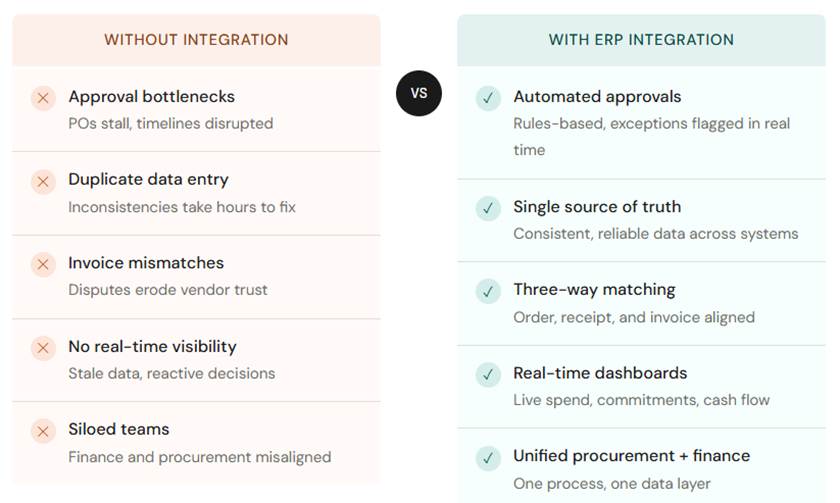
Figure 1: Procure-to-Pay Cycle Problems Without Integration vs. Outcomes with ERP Integration
Despite advances in enterprise technology, many organisations still rely on fragmented, manual approaches to procurement and finance. Email-based approval chains, spreadsheet-driven tracking, and disconnected systems remain common each introducing friction that slows the P2P cycle and reduces data reliability.
Approval bottlenecks cause purchase orders to stall, disrupting timelines and delaying downstream activities. Duplicate data entry creates inconsistencies that consume significant time to identify and correct. Invoice mismatches between what was ordered, received, and billed result in payment disputes that erode vendor trust and divert finance team effort away from higher-value work.
Beyond day-to-day operational impact, the absence of real-time visibility creates a deeper structural problem. Leadership is left making spending decisions based on stale or incomplete data, budget adherence is difficult to monitor, and bottlenecks go undetected until they have already caused delays. The organisation becomes reactive responding to problems rather than preventing them.
How the Integration Works
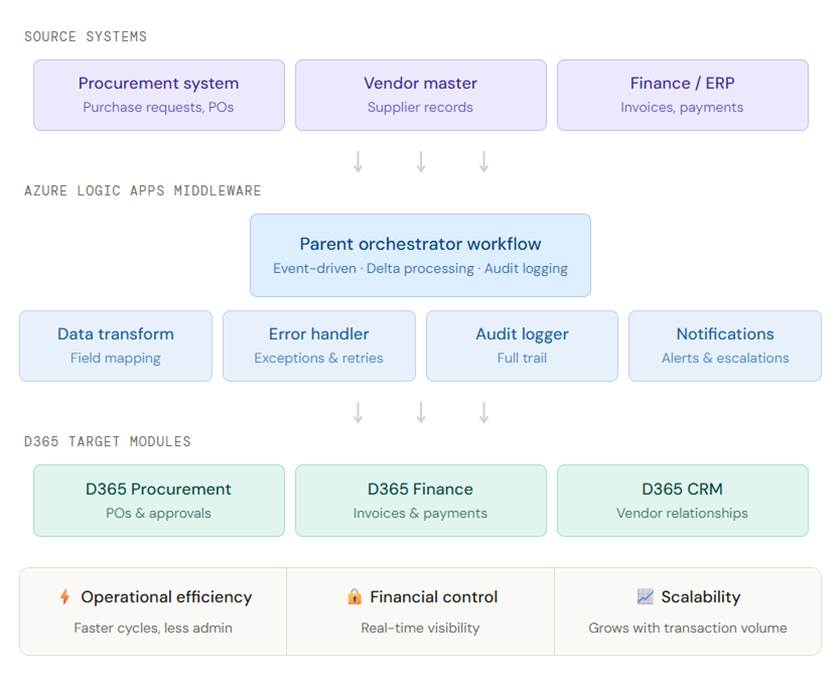
Figure 2: ERP Integration Architecture Source Systems, Azure Logic Apps Middleware, and Target D365 Modules
The integration follows an event-driven model a design approach in which processes are triggered by specific business events rather than scheduled batch runs or manual interventions. This shift has significant implications for speed, accuracy, and responsiveness throughout the P2P cycle.
When a purchase request is created, a vendor record is updated, or an invoice is submitted, the integration layer responds immediately. Data is extracted through secure, authenticated APIs, validated against predefined rules, transformed into the format required by the target system, and pushed into the ERP without human intervention and typically within seconds.
This real-time responsiveness eliminates the latency inherent in batch-based integrations, where data may be hours out of date by the time it reaches the systems that need it. For procurement and finance teams working to tight timelines, that difference is material and directly impacts how quickly decisions can be made and acted upon.
What Changes with Integration
ERP integration addresses these challenges by connecting procurement and finance into a unified, data-consistent system. Rather than information being passed manually between teams or re-entered across platforms, it flows automatically triggered by real business events and governed by standardised rules applied consistently across the organisation.
When a purchase request is raised, all relevant data is immediately available to every stakeholder in the approval chain without manual handoffs or follow-up emails. Approvals are routed automatically based on predefined rules, timelines are enforced, and exceptions are flagged in real time rather than discovered days later during reconciliation.
Standardisation is another significant benefit. With all users working from the same data and the same process definitions, the inconsistencies that arise from team-specific workarounds are eliminated. Audit trails are complete and reliable, compliance becomes easier to demonstrate, and the system can adapt as the organisation evolves without requiring constant manual adjustment.
What Businesses Gain
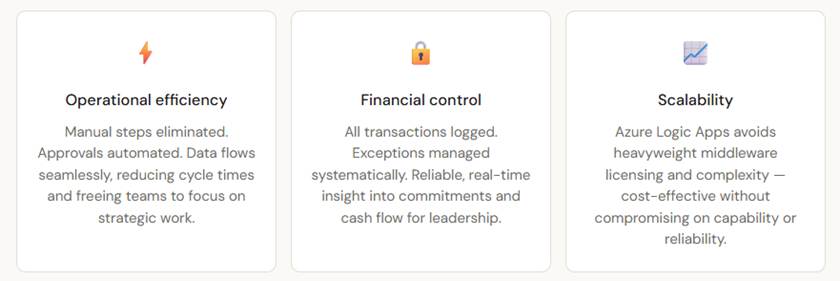
The benefits of a well-integrated P2P system extend across every level of the organisation. Procurement teams process requests and approvals faster, with significantly less administrative burden. Finance teams reconcile invoices more efficiently and gain clearer visibility into outstanding commitments and cash flow. Vendors receive timely, accurate payments improving commercial relationships and, over time, creating opportunities for preferential terms and stronger partnerships.
At the leadership level, integration delivers something particularly valuable: reliable, real-time insight. Executives can monitor procurement activity, track budget adherence, and assess financial performance without waiting for manually compiled reports. This enables faster course correction, more confident planning, and better alignment between procurement strategy and broader business objectives.
Organisations in high-volume, multi-entity environments such as Daimler Truck North America, a leading North American commercial vehicle manufacturer operating brands including Freightliner, Western Star, and Thomas Built Buses across complex, multi-geography supply chains benefit most significantly. In industries where operational precision and cost control are non-negotiable, the ability to manage procurement and payments with full visibility and minimal friction is a genuine competitive differentiator.
To conclude, a well-designed integration does more than automate existing steps it transforms the Procure-to-Pay cycle into a fast, reliable, and transparent process that serves operational teams, finance leadership, and the wider business alike.
The principles outlined in this article event-driven architecture, modular parent-child orchestration, delta processing, and comprehensive logging form the foundation of an integration that can scale with the business and adapt to evolving requirements. For organisations operating in complex, high-volume environments, this is not a technical upgrade. It is a strategic enabler.
Ready to modernize your finance and supply chain operations with Dynamics 365 Finance & Operations?
CloudFronts delivers intelligent automation, seamless integrations, and process optimization solutions that help you maximize the value of your ERP investment. Reach out at transform@cloudfronts.com