

From Multiple Data Sources to Azure Databricks: A Zero-Downtime Power BI Migration for Future AI Readiness
Summary
Every organization wants to be AI-ready. Very few are data-ready. Business data typically lives across ERP, CRM, HR, and finance systems, each handled differently and reported separately. The result is familiar to most leadership teams: reports that do not agree, logic rebuilt in every dashboard, and AI initiatives that stall because the data underneath them cannot be trusted.
This article makes the case for one data platform – a single, governed foundation where all business data is brought together, processed consistently, and made ready for both reporting and AI. We share how we built this at CloudFronts on Azure and Databricks, unifying five business systems and migrating 40+ Power BI reports with zero downtime, and why that foundation is what makes AI use cases practical rather than aspirational.
Table of Contents
1 The Hidden Cost of Scattered Data
2 What One Data Platform Really Means
3 Why It Matters to the Business
4 Solution Architecture Overview
5 Migration Without Disruption
6 From Reporting Platform to AI Foundation
7 AI Use Cases It Unlocks
8 Scattered vs Unified
9 Questions Every Leader Should Ask
10 Where to Start
11 FAQs
12 Conclusion
The Hidden Cost of Scattered Data
Most growing organizations do not set out to fragment their data. It happens one decision at a time. A new ERP for finance. A CRM for sales. An HR system for people. An accounting tool for a specific entity. Each one solves a real problem – and each one becomes another separate source of data.
This project started with our own reporting. Like many growing services organizations, CloudFronts runs its business across several systems: Business Central and Finance & Operations for ERP, Dynamics 365 CRM for clients and engagements, Zoho People for HR, and Zoho Books for accounting. Leadership, finance, HR, and delivery teams rely on more than 40 Power BI reports built on these systems, from management dashboards and HR reports to the Steering Committee report we use to track quarterly meetings with client accounts.
Over time, each system had been connected in its own way. Some data moved through Azure Data Factory, some through SQL Database, and some through Azure Functions. Reports connected directly to their sources, with business logic built inside each one, and they sat across separate workspaces for HR, management, and other teams.
The idea behind the project was simple: instead of continuing to add pipelines and reports system by system, bring all business data into one trusted platform on Azure Databricks, migrate every existing report onto it without disrupting the people who use them, and build a foundation that is ready for AI in the process.
None of the old setup looked broken on any given day. But the costs were real, and they compounded as the business grew.
Numbers That Do Not Agree
When the same metric is calculated in several reports, small differences appear. Leadership meetings start with reconciling numbers instead of acting on them.
Effort That Keeps Growing
Every new report means another connection, another copy of the logic, and another refresh to maintain. The effort grows with every report added.
Governance That Is Hard to Enforce
When reports sit in different workspaces with different owners, controlling who sees what becomes a manual, error-prone exercise.
Data That Is Not Ready for What Is Next
AI and advanced analytics need clean, connected data. Scattered data means every AI idea starts with a data consolidation project first.
“The data was never the problem. The problem was that it lived in five places, and every system handled it differently.”
What One Data Platform Really Means
One data platform is not just a new database or a bigger data warehouse. It is a change in how the organization treats its data – from something each system and report manages on its own, to a shared business asset managed once, for everyone.
Functionally, it comes down to four commitments:
1One place for all business data – Every source system feeds a single platform, so finance, sales, HR, and operations data sit side by side and can be connected.
2One way of processing it – Every source goes through the same standardized stages, so data is cleaned and shaped consistently no matter where it came from.
3One definition of every business rule – Business logic – how revenue is grouped, how a meeting is classified, how an employee is counted – is defined once and reused everywhere.
4One layer of governance – Access is controlled centrally by role, so the right people see the right data without each report owner managing permissions separately.
Why It Matters to the Business
For leadership, the value of one data platform shows up in outcomes rather than architecture.
A Single Source of Truth
Every report reads from the same curated data, so the numbers agree across finance, operations, and management reporting.
Faster Answers, Less Rework
New reports and new data sources are added through configuration, not rebuilt from scratch. Teams spend time on insight instead of plumbing.
Stronger Governance by Design
Centralized, role-based access means security is enforced by the platform, not by individual report owners.
Lower Long-Term Complexity
One pipeline and one framework replace a patchwork of tools, reducing maintenance and dependency on specific individuals.
Scales With the Business
Adding a new system or entity follows the same pattern, so growth does not multiply reporting complexity.
A Foundation for AI
Clean, connected, governed data is exactly what AI, machine learning, and process mining need to deliver reliable results.
Solution Architecture Overview
We built our one data platform on Azure and Databricks. Here is how it fits together, from five source systems to a single, governed Power BI workspace.
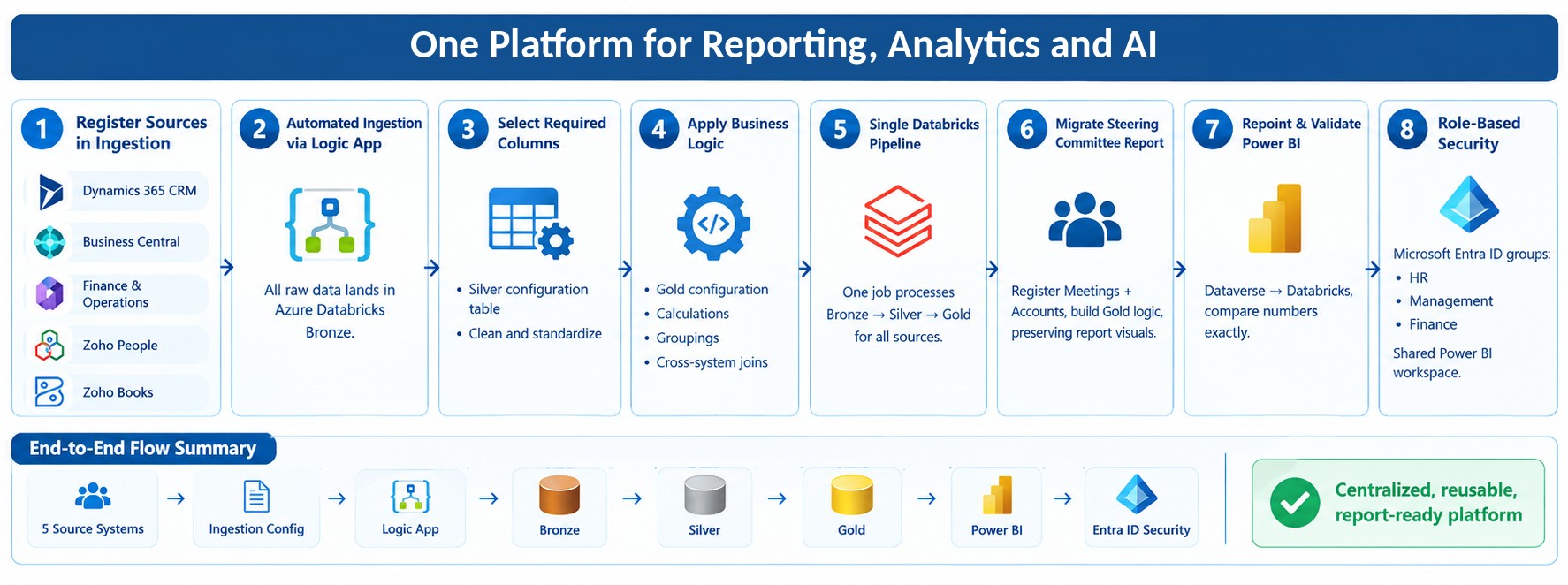
How the Architecture Works
Step 1: Connect the Source Systems
Business Central, Finance & Operations, Dynamics 365 CRM, Zoho People, and Zoho Books are registered once in a central ingestion list that tells the platform what data to bring in.
Step 2: Bring Data In Automatically
Azure Logic Apps read that list and pull the data from every system into Azure Databricks. All raw data lands in one place, the Bronze layer.
Step 3: Keep Only What Matters
In the Silver layer, only the data needed for reporting is kept, then cleaned and standardized so every source looks consistent.
Step 4: Apply Business Rules Once
In the Gold layer, calculations, groupings, and connections across systems are applied once, creating trusted, business-ready data.
Step 5: Run One Pipeline for Everything
A single Databricks job moves data from all sources through Bronze, Silver, and Gold. There is no separate pipeline for each system.
Step 6: Move Reports onto the Platform
Existing Power BI reports are pointed to the Gold layer instead of their original sources. Layouts, filters, and visuals stay exactly the same.
Step 7: Validate Before Switching
Each migrated report is compared with the original to confirm the numbers match, so users are never disrupted.
Step 8: Control Access by Role
All reports live in one Power BI workspace, and Microsoft Entra ID groups such as HR, Management, and Finance decide who can see which reports.
Migration Without Disruption
The hardest part of moving to one data platform is rarely the technology. It is the risk of disrupting the people who rely on existing reports every day. A traditional migration rebuilds each report by hand – slow, inconsistent, and visible to every user.
Because our framework is configuration-driven, migrating a report became a repeatable routine rather than a rebuild: register the source data, select the fields the report needs, define its business logic once, run a single pipeline, and repoint the report to the curated data. Each migrated report was validated against the original before switch-over, so the numbers matched exactly.
Take our Steering Committee Meeting Report, which tracks quarterly steering committee meetings across client accounts. It originally connected directly to Dataverse, with its logic built inside the report. After migration, it reads the same information from the Gold layer in Azure Databricks. Same layout, same filters, same visuals – users noticed nothing, except that the report now sits on a foundation shared with every other report.
40+ Reports Migrated
Moved onto one platform using the same repeatable framework.
5 Systems Unified
Business Central, F&O, CRM, Zoho People, and Zoho Books in one place.
Zero Downtime
No disruption to users and no retraining required.
From Reporting Platform to AI Foundation
Here is the part that matters most for the years ahead. Most AI initiatives do not fail because of the model. They fail because of the data. An AI assistant cannot answer a question about customer profitability if customer data lives in the CRM and invoice data lives in two different accounting systems. A forecasting model cannot be trusted if the history it learns from is calculated differently in every report.
One data platform removes that barrier. When data from every business system is already unified, cleaned, governed, and connected in the Gold layer, AI use cases can build directly on top of it. There is no separate data consolidation project to fund first, and no debate about whose numbers are right.
In other words, the work done to fix reporting is the same work that makes the organization AI-ready. Every report migrated onto the platform is also another trusted dataset available for AI.
“You do not become AI-ready by buying AI. You become AI-ready by getting your data into one trusted place.”
AI Use Cases a Unified Platform Unlocks
With data from ERP, CRM, HR, and finance systems in one governed platform, a new set of use cases becomes practical. These are the kinds of questions a unified foundation makes it possible to answer:
Conversational Analytics
Ask Your Data in Plain English
Business users ask questions in natural language and get answers from governed data, without waiting for a new report.
“Which accounts missed a steering committee meeting this quarter?”
Predictive Insights
Forecast What Comes Next
Machine learning models learn from consistent historical data across sales, finance, and operations to forecast revenue, cash flow, or demand.
“What is our expected revenue next quarter based on the current pipeline?”
Risk Detection
Spot Problems Before They Escalate
AI combines signals from multiple systems – billing, delivery, customer communication – to flag risks early.
“Which projects show early signs of delivery or payment risk?”
Process Mining
See How Work Really Flows
Connected event data across systems reveals bottlenecks and delays in end-to-end processes such as order-to-cash or hire-to-retire.
“Where does our order-to-cash process slow down most often?”
Customer Landscape
One View of Every Customer
CRM, invoicing, and support data combined to understand customer health, profitability, and retention risk.
“Which customers have rising support cases and overdue invoices?”
Workforce Analytics
Understand Your People Data
HR data connected with project and financial data to understand utilization, capacity, and cost.
“How does team utilization compare with revenue by business unit?”
This is not theoretical for us. Our Project Risk Engine is an example of what becomes possible once business data sits on Azure Databricks: it reads project, billing, and communication data to score project health and answers questions in plain English through Databricks Genie.
Scattered Data vs One Data Platform
Questions Every Leader Should Ask About Their Data
If you are deciding whether your organization needs one data platform, these questions are a useful starting point:
1How many places is our business logic defined? – If the same rule lives in many reports, every change becomes a multi-report exercise and a consistency risk.
2What does adding a new system cost us? – If each new application means a new pipeline and new reports, complexity will keep growing with the business.
3Could we start an AI initiative tomorrow? – If the first step of any AI idea is gathering and cleaning data from several systems, the foundation is not ready yet.
Where to Start
Frequently Asked Questions
Conclusion
Scattered data is a quiet cost. It shows up as reports that disagree, logic rebuilt in every dashboard, governance that depends on individuals, and AI ambitions that never quite get started.
One data platform changes the equation. By bringing every business system into a single, governed foundation on Azure and Databricks, we unified five systems, migrated 40+ Power BI reports without disrupting a single user, and created a trusted base for the AI use cases that come next.
We built it to solve our own problem first. The lesson we would share with any leadership team is simple: the path to AI runs through your data foundation. Get the data into one trusted place, and the use cases follow.
Watch the Webinar
See the framework in action. In our live session, we walk through the platform architecture, how reports are migrated without disruption, and a live demo moving a Power BI report from Dataverse to Azure Databricks.
Webinar RecordingReady to Build Your AI-Ready Data Foundation?
If your reporting depends on multiple systems and your AI ambitions keep running into data problems, we can help you plan a unified platform and a migration that does not disrupt the business.
Connect with Us →About the Author

Bhavika Shetty
Data Engineer · CloudFronts
I’m Bhavika Shetty, a Data Engineer at CloudFronts with almost 3 years of experience building practical solutions with data, cloud, and AI across Azure, Databricks, Power BI, and Dynamics 365, with exposure to SAP and InforLN. I’ve explored Databricks AI Modules through the Project Risk Engine / PMO Assistant, using Databricks Genie and Llama models to identify project risks, and I enjoy turning complex data challenges into simple, scalable solutions with real business impact.
Specialization: Data Engineering, Databricks, Azure, Power BI, Dynamics 365, Data & Analytics.